
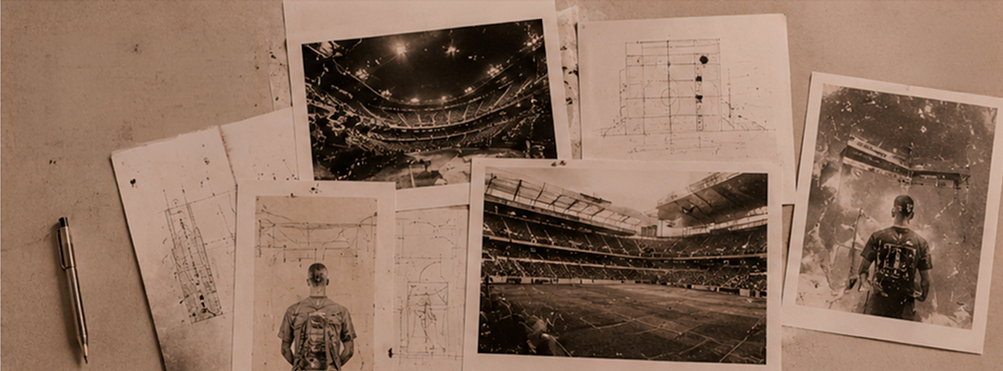
Not every design belongs on a garment. Some work better still, at a fixed size, on a wall. Deciding which is which turned out to be one of the more useful questions in the studio.
A wall gives you detail, a body gives you movement
A print on paper can hold fine linework and small type, because it is viewed up close and it never moves. The same artwork on a shirt is seen from a few metres away, on a surface that folds and shifts. Detail that rewards close reading simply disappears.
Designs that only work as prints
Dense compositions, anything with legible text, and images that depend on precise proportion stay as posters. Stretch a carefully balanced composition across a chest and the balance goes with it.
Designs that only work worn
Some drawings need a body to make sense. A gesture, a figure mid movement, a mark that follows the line of a shoulder. Framed on a wall these can look incomplete, because the thing they were drawn against is missing.
Why the same image sometimes appears twice
Occasionally a design earns both formats, but never identically. The wall version keeps its full detail. The worn version is redrawn simplified, with heavier line weight and more space. It is the same subject treated twice, not one file printed on two surfaces.
If you are choosing between them, the practical question is whether you want to look at the piece or carry it. Both are valid, and they are genuinely different objects.