
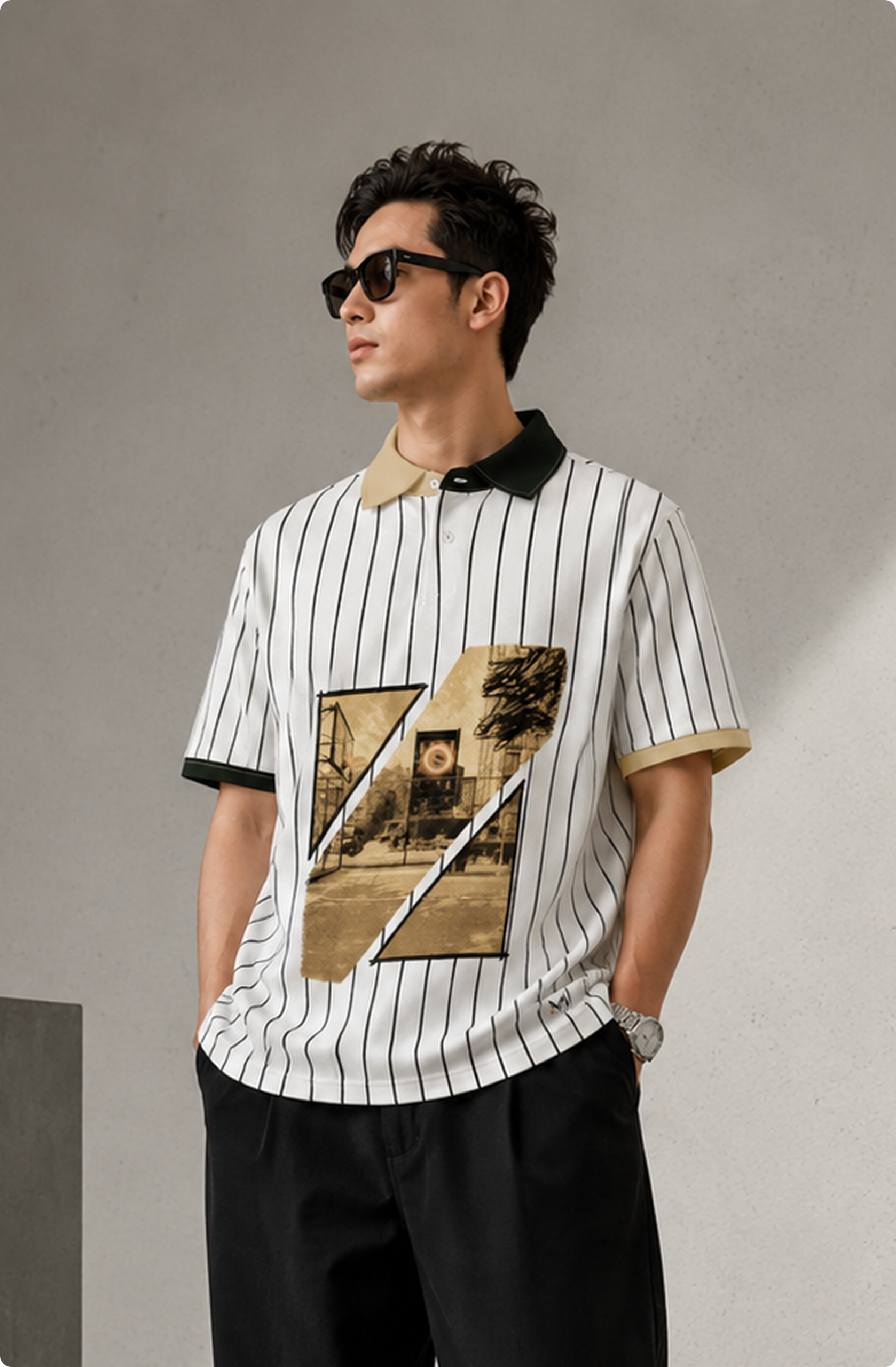
Sports photography usually lives in two places: a newspaper page or a screen. It is consumed quickly and replaced the next day. Golden Frame came from asking what happens if you treat one of those images the way a gallery treats a portrait.
Framing changes how you read an image
Put a photograph behind glass with a border and people slow down. The same picture in a feed gets two seconds. We built the collection around that effect: each piece places a single image inside a defined frame on the garment, with space around it, so the eye stops instead of scanning.
Why sepia rather than full colour
Colour dates an image immediately. You can usually guess the decade from the film stock alone. Reducing the image to warm monochrome takes that marker away, and what remains is the gesture: a body mid movement, a crowd, a stadium. It reads as a moment rather than a specific year.
Gold used as punctuation
The gold in this collection is deliberately limited. It appears at the frame edge and in small accents, never across the whole piece. Used sparingly it suggests value. Used generously it looks like costume. That restraint is the difference between something you wear regularly and something you wear once.
Built on a polo, not a tee
The collar matters here. A polo carries a slightly more formal line than a t-shirt, which supports the idea of a framed image rather than a printed slogan. It also gives the piece a wider range: it works with tailoring as easily as with denim.
Golden Frame is produced in limited runs. Once a frame is retired, that image is not reprinted.